




Most email security is built around the premise - is this message safe to let into the organization's perimeter?” But today’s account takeover attacks are creating harder problems. For instance, what happens when the attacker is not sending from a suspicious domain, spoofing an executive, or attaching obvious malware? Or what happens when the attacker is already inside a legitimate email account?

Email remains one of the main ways businesses exchange contracts, financial information, customer records, employee data, and other sensitive content. But choosing secure email for business is no longer simply a matter of finding a solution or tool that encrypts messages.
Email attacks are no longer arriving as obvious spam or malware. Some attacks contain no malicious attachment; rather, they rely on trust, urgency, payment context, and normal business behavior. For instance, a convincing message may imitate an executive, use a supplier’s compromised account, continue an existing conversation, or persuade an employee to send sensitive information to the wrong person.

The majority of healthcare teams are exchanging sensitive protected health information (PHI) via email with patients, insurers, labs, billing teams, attorneys, and care partners. The very nature of the exchange makes it a risky proposition.
Threat intelligence often has a slightly glamorous (and serious) association with spying and national security activities. In email security, however, it’s slightly unglamorous; mostly involving the use of threat data, behavioral signals, sender context, domain reputation, message patterns, and recipient activity to judge whether an email is safe, suspicious, or dangerous.
Email attacks are now built around timing. A phishing email does not need to sit in an inbox for days to create damage. A user can click in minutes, a finance team can act on a fake vendor request before anyone checks the sender, a malicious link can look harmless at delivery and turn dangerous later, or a reply can come from a compromised account inside a trusted thread and bypass the usual suspicion that comes with a new sender.

Most cyberattacks don’t look malicious anymore; rather, they’re as normal as they can be. An email arrives from a known vendor, the tone matches past conversations, the timing aligns with an active transaction... Nothing triggers suspicion until money moves or data leaks.
Enterprises already know that the inbox is one of the easiest ways for attackers to get into the business. The real question is narrower: when vendors say they use AI-based email security, what actually changes compared with rule-based, traditional email security?
Just a year or so ago, email security was mostly about blocking what looked obviously bad, such as known malicious links, suspicious attachments, spoofed domains, and spammy language. All of that is still relevant, but today’s attacks often look normal, timely, and believable with AI. And it’s why AI itself has become critical in email security.
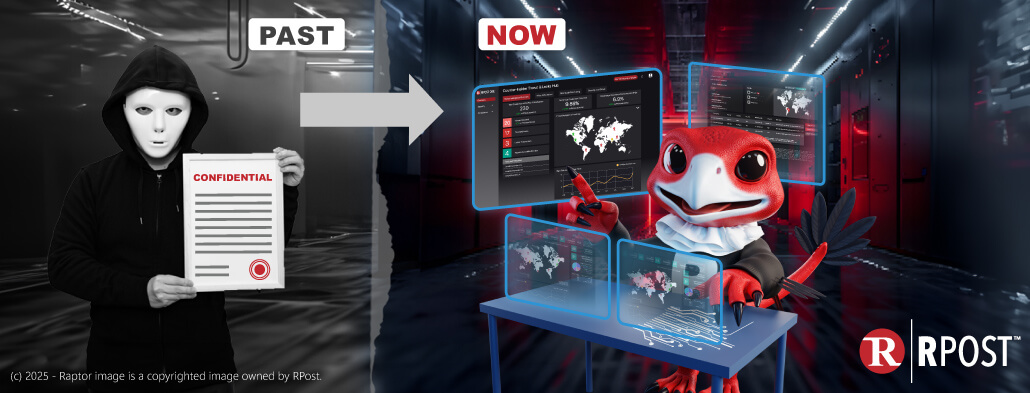
Hey there, Rocky the Raptor here, swooping in to chat about a big shift in the world of cyber threats. Back in the day, companies (especially law firms) worried a lot about what we used to call a “Man-in-the-Middle” attack.
September 25, 2026
August 21, 2026
July 31, 2026
July 07, 2026
June 19, 2026