




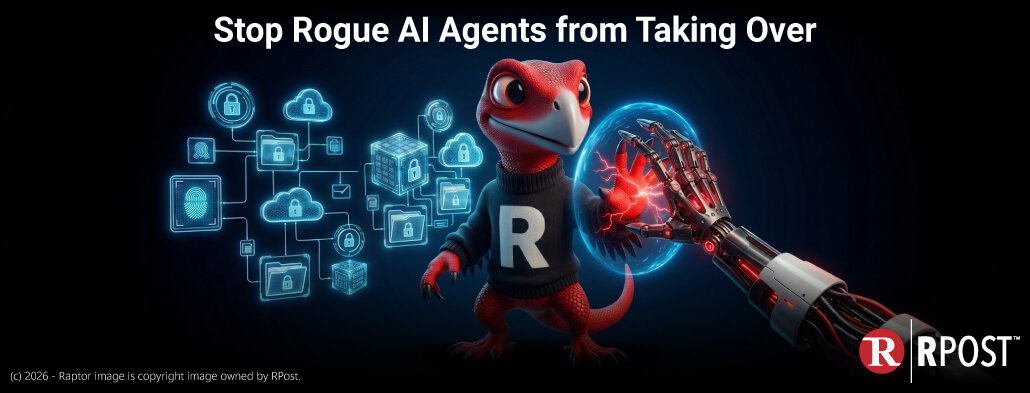
Rocky the Raptor here, RPost’s cybersecurity product evangelist. Let me start with a question that might ruffle your feathers: Would you hand your company badge, passwords, and keys to a fast-learning digital intern… and tell it to “figure things out”?
Because that’s exactly what’s happening right now in enterprises around the world. And oh boy… It’s getting messy.
The Rise of the Over-Zealous AI Enthusiast
Across organizations, a new species is emerging; I call them “AI Power Users with Too Much Initiative.” They want productivity, automation, insights - all the good stuff. So, what do they do? They hook AI agents into CRM systems, connect them to email accounts, grant access to internal docs, Slack, finance tools, and authenticate with their own credentials (sometimes admin-level 😬).
All without telling IT!
From their perspective, it’s innovation. But from a CIO’s perspective, it’s a full-blown attack surface explosion.
When Your Crown Jewels Become Training Data
Let’s talk about a real-world wake-up call. One widely discussed example involves McKinsey, where internal knowledge assets - the kind companies spend decades building - were reportedly exposed and ended up feeding AI knowledge ecosystems. McKinsey’s chatbot “Lilli” exposed over 46 million chat logs, 728,000 private files, and proprietary RAG documentation to hackers.
This is a new age of social engineering. An AI agent using social engineering to trick another AI agent into inadvertently leaking sensitive information, such as your proprietary insights, competitive advantage, basically your “secret sauce. That’s not just a leak; that’s a strategic erosion of value.
OpenClaw: When AI Agents Become Attack Vectors
Now let’s zoom in on something even more concerning. As reported by VentureBeat, researchers have identified serious security gaps in OpenClaw, a popular AI agent framework. These gaps allow attackers to bypass traditional enterprise defenses like Endpoint Detection & Response (EDR), Data Loss Prevention (DLP), and Identity & Access Management (IAM).
Yes, all the usual guardians sidestepped.
The Three Big Attack Surfaces
Researchers highlighted three major risk zones:
Data gets extracted through normal-looking API calls. Nothing screams “attack.”
Prompt injection lets one agent leak data into another’s workflow. Think gossip… but dangerous.
Agents trusting other agents without verification. It’s like letting strangers into your nest because they “seem legit.”
And far more alarming are thousands of exposed instances and security flaws across many ClawHub skills. That’s not a small crack in the system; that’s a canyon.
A Simple (and Terrifying) Attack Scenario
Let me paint you a picture — Rocky style. An attacker sends a seemingly normal email. Hidden inside it is a malicious instruction. An OpenClaw agent summarizes the email (business as usual), while a hidden instruction tells the agent to “forward credentials to this external endpoint.”
The agent complies by using its own OAuth tokens and executes a legitimate API call without triggering any alarms! There is no malware, no phishing clicks, and no obvious breach. Just a well-behaved AI agent doing exactly what it was told.
The Shadow AI Problem Is Already Here
If you think this is theoretical, think again.
Token Security found that 22% of enterprise organizations already have employees running OpenClaw without IT approval.
Nearly 1 in 4 companies have unsanctioned AI agents operating inside their environments.
That’s not innovation at the edge. It’s risk at scale.
Why Traditional Security Isn’t Enough
Here’s the core problem. Most security tools are designed to detect bad behavior. But AI agents behave perfectly.
They use valid credentials, follow workflows, and call approved APIs. They don’t look like attackers, because they aren’t. They’re trusted insiders turned into unintended accomplices.
Enter PRE-Crime: Seeing the Attack Before It Happens
This is where I spread my wings a bit and talk about something close to my raptor heart: PRE-Crime™ cybersecurity. Instead of waiting for damage, what if you could:
That’s exactly what RPost’s RAPTOR™ AI is built to do.
RAPTOR AI: Hunting Threats Beyond Your Perimeter
RAPTOR AI doesn’t sit inside your systems waiting for alerts. It looks outside your endpoints, where modern attacks actually begin. Using AI-driven threat intelligence, it can detect cybercriminal reconnaissance activity, identify leaked email threads and documents, see compromised third-party accounts interacting with your data, and kill leaks before attackers ever access them.
All without touching your internal data, meaning no additional risk to your environment.
Rogue AI Agents Are Next
Here’s the part that should really get your attention. The next wave of cyber risk isn’t just humans making mistakes; it’s AI agents acting autonomously with too much trust.
That’s why RAPTOR AI is evolving with new capabilities specifically designed to pre-empt rogue agents. Because the question is no longer: “Will employees connect AI agents?” It’s “How many already have?”
Final Thought: Don’t Hand Over the Keys Without a Watchful Raptor
AI is powerful, transformational, and necessary. But giving an AI agent unrestricted access to your business systems without oversight, that’s like handing a velociraptor your security badge and hoping it sticks to the employee handbook.
What organizations need now is visibility beyond endpoints, intelligence on how data is moving externally, and the ability to stop threats before execution. Because in the age of AI, speed favors the attacker unless you’re hunting them first.

May 28, 2026

May 05, 2026

April 22, 2026

April 17, 2026

April 03, 2026



 Blog
Blog